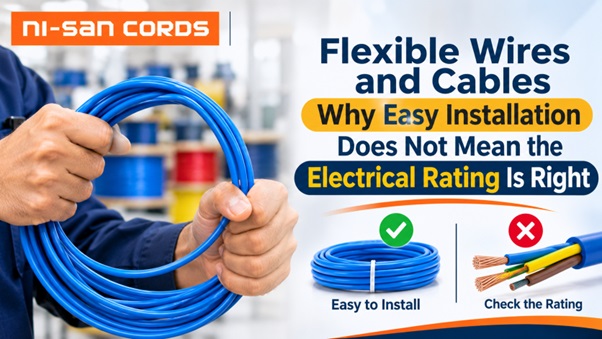
The softest cable on the bench is not necessarily the right cable for a crowded panel. It may tuck neatly around a corner, but that tells you nothing about heat build-up in a bundle, voltage drop on a long run or whether the insulation suits the surrounding conditions. Mechanical flexibility and electrical suitability need separate checks.
What flexibility actually describes
Flexibility depends on conductor construction, strand diameter, insulation and sheath materials, overall diameter and the geometry of the cable. A highly stranded conductor may bend more readily than a solid conductor of similar nominal area, but the full cable construction determines how it behaves. The word ‘flexible’ in a sales description is not a substitute for a defined conductor class or application rating.
One-time installation bends and repeated movement are different mechanical duties. A static panel lead may need to negotiate a tight route only once; a cable on a moving machine axis may undergo thousands of cycles. General product catalogues (visit website) can identify available cable categories but rarely settle suitability for continuous movement. The design should specify bending radius, movement pattern, torsion and expected cycles, with validation appropriate to the duty.
Electrical sizing comes first
Start with the load, not how soft the sample feels. A directory of ‘Flexible wires & Cables manufacturers India‘ may help with sourcing, but it does not establish the cable’s current rating in a particular installation. Provide the current, duty cycle, supply voltage, route length, grouping, ambient temperature and permissible voltage drop. A single wire in free air does not shed heat in the same way as several loaded conductors bundled inside a warm enclosure. The cable selection has to account for the installation, not just the conductor size printed on the coil.
Check the insulation’s temperature rating and the effect of nearby heat sources. A cable may be correctly sized at room temperature but require derating in a warmer cabinet or conduit. Use the applicable design standard and manufacturer data rather than copying an ampacity figure without its assumptions.
Installation space introduces new risks
Small bend radii can damage insulation, distort cable geometry or stress terminals. Measure the available routing envelope and use the manufacturer’s minimum bend-radius guidance. Provide strain relief so terminal screws or crimps are not asked to carry cable weight or repeated movement.
In tight panels, distinguish conductor size from finished outer diameter. Two cables with the same nominal copper area can have different insulation thickness, sheath construction and outside dimensions. Verify compatibility with glands, ferrules, terminals and routing channels before placing a bulk order.
Look beyond the initial fit
An installer may prefer a soft cable because it is easy to pull through a route. The maintenance team may care more about clear core marking, abrasion resistance and access for replacement. The design team must consider fire and environmental requirements where applicable. A sound selection balances these needs rather than optimising only the installation experience.
Practical selection sequence
First confirm electrical duty and environmental requirements. Next select conductor and insulation construction. Then check dimensions, bending and termination compatibility. Finally test the cable in the actual installation, including door closure, vibration points, cable ties, gland entry and service access. Document the approved product so a future purchase does not silently change the build.
Questions from the installation team
Does a higher strand count mean the wire can carry more current? Not by itself. Current capacity depends on conductor area, resistance, insulation temperature limits and how the wire is installed.
Can a soft-feeling cable be bent tightly around a corner? No. Check the stated minimum bend radius and make sure the terminal or gland is not carrying the bending load.
Can a general flexible wire be used on a moving machine axis? Do not assume so. Repeated bending and torsion are different duties from one-time installation; ask for a construction validated for the actual movement.